Venture Deal Flow: How to Build a Pipeline That Converts

Venture deal flow is the rate and quality of investment opportunities that reach an investor. It is the input side of the funnel: every startup a partner sources, screens or receives inbound becomes a candidate for diligence and, eventually, a term sheet. The firms that see the best companies first win their categories, and seeing them first increasingly depends on structured company data that finds targets before they announce a round. That is the work Milda is built for: a database of over 420 million companies and 50 million verified contacts, with growth signals, ownership and financial detail in one place.
TL;DR
- Deal flow is a quality measure as much as a volume measure: a smaller, better-matched pipeline beats a large, noisy one.
- In a survey of 885 VCs, about six in ten closed deals came through relationships, and 28% were proactively self-generated by the firm.
- The median firm considers roughly 100 opportunities for each deal it closes, so screening speed decides how much attention reaches the best ones.
- Outbound sourcing lets you reach a company before it fundraises, which can mean less competition and better terms.
- Company data, signals and verified contacts make outbound repeatable instead of dependent on one well-connected partner.
Table of Contents
- What venture deal flow actually means
- The funnel math: how many opportunities make one investment
- Where closed deals come from
- Why outbound sourcing improves the economics
- Building a repeatable deal flow process
- Measuring quality, not just volume
- Where data and software help
- Our perspective
- Put your sourcing on data
- FAQ
- Sources
What venture deal flow actually means
Deal flow covers every opportunity that crosses an investor’s desk: a pitch deck from a founder, an introduction from another fund, a company your analyst flagged. One glossary definition frames it as the rate and quality of opportunities reaching a firm, the top of the funnel that feeds screening, diligence and term sheets.
The word “quality” matters. Two funds can each review 1,500 companies a year, but the one whose pipeline is matched to its thesis spends its hours on better candidates. Counting pitches tells you how busy you are. It does not tell you whether the right companies are reaching you.
The funnel that follows is familiar. The Darden School’s VC learning series describes the standard stages as sourcing, screening, partner review, due diligence, term sheet and closing. Everything downstream depends on what enters at the top.
The funnel math: how many opportunities make one investment
The most cited benchmark is the survey by Gompers, Gornall, Kaplan and Strebulaev of 885 venture capitalists at 681 firms, published as NBER Working Paper 22587. Its funnel, per closed deal, as summarized here:
| Stage | Approximate count per closed deal |
|---|---|
| Companies considered | 101 |
| Management teams met | 28 |
| Reached partner review | 10 |
| Due diligence | 4.8 |
| Term sheets offered | 1.7 |
The median firm closes about four deals a year and considers roughly 100 opportunities for each. Due diligence is expensive: the same survey reports an average of 118 hours over 83 days per closed deal, with about 10 reference calls.
A worked example
Take a seed fund that plans 30 investments over four years, about eight a year. Applying the survey rates, it needs roughly 800 opportunities considered each year, about 15 a week, to produce around 200 first meetings, 64 partner reviews and 32 diligences. If your team sees 300 a year, you are not short on judgment. You are short on pipeline.
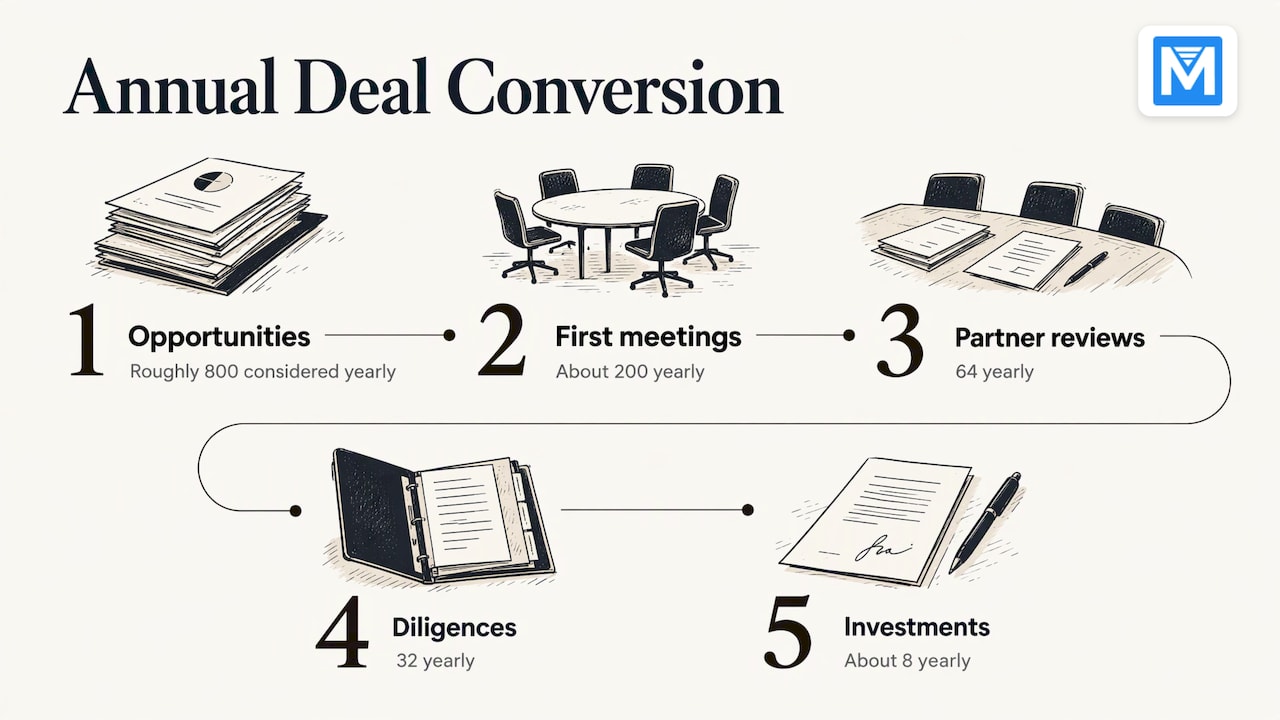
Stage and sector change the numbers. The NBER paper finds that IT firms consider 151 deals per investment against 78 for healthcare firms, and that late-stage firms offer about 50% more term sheets per close than early-stage firms, a sign of tougher competition for later-stage deals.
Where closed deals come from
The same survey breaks closed deals down by source, as reported here:
- Professional network: 31%
- Proactively self-generated by the firm: 28%
- Referred by other investors: 20%
- Inbound from company management: 10%
- Referred by portfolio companies: 8%
Two lessons follow. First, relationships dominate, and the authors stress that few investments come from entrepreneurs who simply knock on the door. Second, more than a quarter of closed deals were generated by the firm itself. Outbound is not a fringe tactic. It is a primary channel.
Warm versus cold
UK data cited by VentureBeat shows half of a fund’s deal flow arrives cold and 39% warm, yet warm leads are 13 times more likely to reach committee and be funded. Unsolicited inbound is mostly noise. The useful move is not to wait for more of it but to originate warm-quality conversations yourself, with a company you chose for a reason.
That approach also widens who you see. The same report found all-female founding teams were less likely to have a warm introduction than all-male teams (36% against 40%), and an Oxford Capital partner argued that proactive origination diversifies portfolios beyond what a network alone produces.
Stage changes the mix
Seed and Series A deal sourcing is heavily network-driven, and late-stage investing tends to be more outbound, with associates reaching out to companies directly. If you invest later, or in a defined niche, a systematic outbound engine pays off sooner.
Why outbound sourcing improves the economics
The Darden material notes that approaching a company before it starts fundraising can yield less competitive deals and more attractive pricing and terms. By the time a round is running, several funds are looking at the same deck. Getting there earlier changes your position at the table.
Outbound has one practical requirement: you need to know which companies fit, what they are doing, who owns them and who to call. Without that, outbound is a list of guesses.
Building a repeatable deal flow process
A process that survives turnover has five parts.
- Define the thesis in data terms. Sector, geography, size, growth pattern, ownership structure. Our guide to investment thesis data covers what to gather before you search.
- Map the universe. List every company that could fit, not only the ones you have heard of. Our piece on company sourcing strategies walks through the options.
- Prioritize with signals. Hiring surges, new patents, funding events, leadership changes and ownership shifts tell you which companies to contact this month. See our overview of private market intelligence.
- Screen in two stages. The IADB’s venture fund toolkit prescribes a quick investment memo to find deal breakers before committing to detailed diligence, which only follows investment committee confirmation. This protects the 83 days that full diligence takes.
- Track source and outcome. Record where every deal came from and what happened to it. LPs ask where the pipeline originates and what share of closed deals came from cold outbound versus warm introductions. If you cannot answer, you cannot show a sourcing edge.
Technology-enabled workflows are worth studying too, for example how third-party review signals shape the way AI startups present themselves to the market, which in turn affects how you read their public footprint.
Measuring quality, not just volume
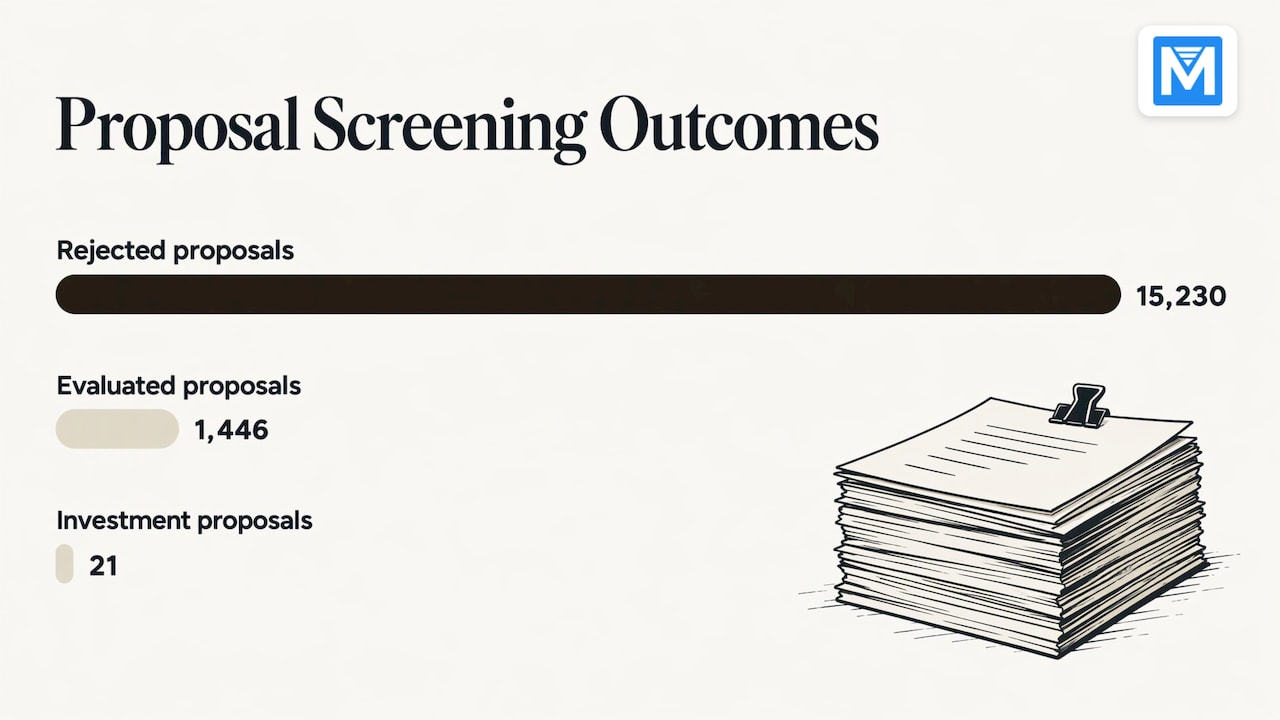
A Babson study of 16,676 deal proposals screened by a European early-stage fund between 2017 and 2020 shows how steep the filter is: 15,230 were rejected at screening, 1,446 were evaluated, and 21 became investments. The management team criterion had the strongest effect on whether a deal continued, and the influence of the referral source faded at the second stage once more information was available.
Metrics worth tracking:
- Thesis-fit rate: the share of sourced companies that pass first screening.
- Source-to-meeting conversion: by channel, so you know which sources deserve more time.
- Time to first contact after a trigger event.
- Proprietary share: deals where you were the first or only investor in the conversation.
Deal flow matters, but it sits inside a larger system. In the NBER survey, deal flow was important to 65% of VCs and most important to 23%, while deal selection was most important to 49%. A strong pipeline gives selection something good to choose from.
Where data and software help
AI tools are already part of daily work for many funds. A CTech survey of Israeli funds found most rated AI’s influence at 7 out of 10 or higher, and one fund’s custom agents surfaced three to four times more qualified leads weekly. The consistent theme is that software extends human judgment rather than replacing it.
In practice, data supports three jobs: finding companies that match the thesis, qualifying them with ownership, financial and growth information, and reaching the right person. Our data coverage page explains what the database contains. If you evaluate providers, our data vendor scorecard lists the criteria to compare.
Our perspective
Most funds tell us the same thing: the best deals came from people they know, and that network took years to build. We agree that relationships close deals. But a network only shows you what your contacts happen to see.
We built Milda so that sourcing starts from the thesis, not from who called this week. With over 420 million companies and 50 million verified contacts, multi-source data and event-driven growth signals, a team can find companies that fit before any deck arrives, see who owns them and reach the decision-maker directly. Our approach is designed to surface up to three times more companies than other sources.
The result we care about is a pipeline that does not depend on one well-connected partner, where every opportunity has a documented reason for being there.
Vilius Stanciauskas, Founder and CEO
Put your sourcing on data
Milda gives investment teams company search, ownership and shareholder detail, financials, risk assessments, patents and growth signals through a web app, a browser extension and an API. Product lines are Browser Analyst, Strategy Terminal and Data Solutions, with pricing that adapts to team size and data usage. See the options on our pricing page.

If your team also scouts partners or acquisition targets, the same data supports partner scouting and M&A signals.
FAQ
What is a good deal flow for a venture firm?
It is one that is matched to your thesis and large enough to feed your target investment pace. A seed fund aiming for eight investments a year needs on the order of 800 opportunities considered, based on the survey funnel. Quality shows in the thesis-fit rate, not in raw counts.
How do you find startup deal flow?
Combine relationships with proactive sourcing. Professional networks and investor referrals supply a large share of closed deals, and about 28% were self-generated by the firm. Searching a company database by sector, size and growth signals is how outbound becomes systematic.
Is inbound or outbound deal flow better?
They do different jobs. Inbound is high in volume but low in conversion: cold approaches were about 64% of what firms saw but only about 6% of what they funded, according to an analysis of VentuRank data. Outbound lets you choose companies and approach them early, often before a competitive round.
How many deals does a VC look at per investment?
The median firm considers roughly 100 opportunities for each deal it closes. About 28 of those reach a management meeting and around 5 reach due diligence. The figure is higher in IT than in healthcare.
Sources
- Deal Flow glossary, Auryn VC
- Deal Sourcing, Analysis and Due Diligence, Darden VC Learning Series
- How Do Venture Capitalists Make Decisions? NBER Working Paper 22587
- Venture Capital Deal Flow: Funnel, Metrics, and Tracking
- Decisions, NBER conference paper
- Venture Capital Deal Sourcing: How Firms Source at Scale
- Hey, VCs: It’s time to do outbound searches, VentureBeat
- The 4-S’s of venture capital, Merus Capital
- Venture Capital Fund Toolkit, IADB
- It’s a Process, Isn’t It? Venture capital decision-making, Babson
- How AI became the ultimate partner for venture capitalists, CTech
- Why AI Startups Trust Third-Party Reviews to Scale Up