Procurement Data Enrichment: Turn Supplier Records Into Decisions
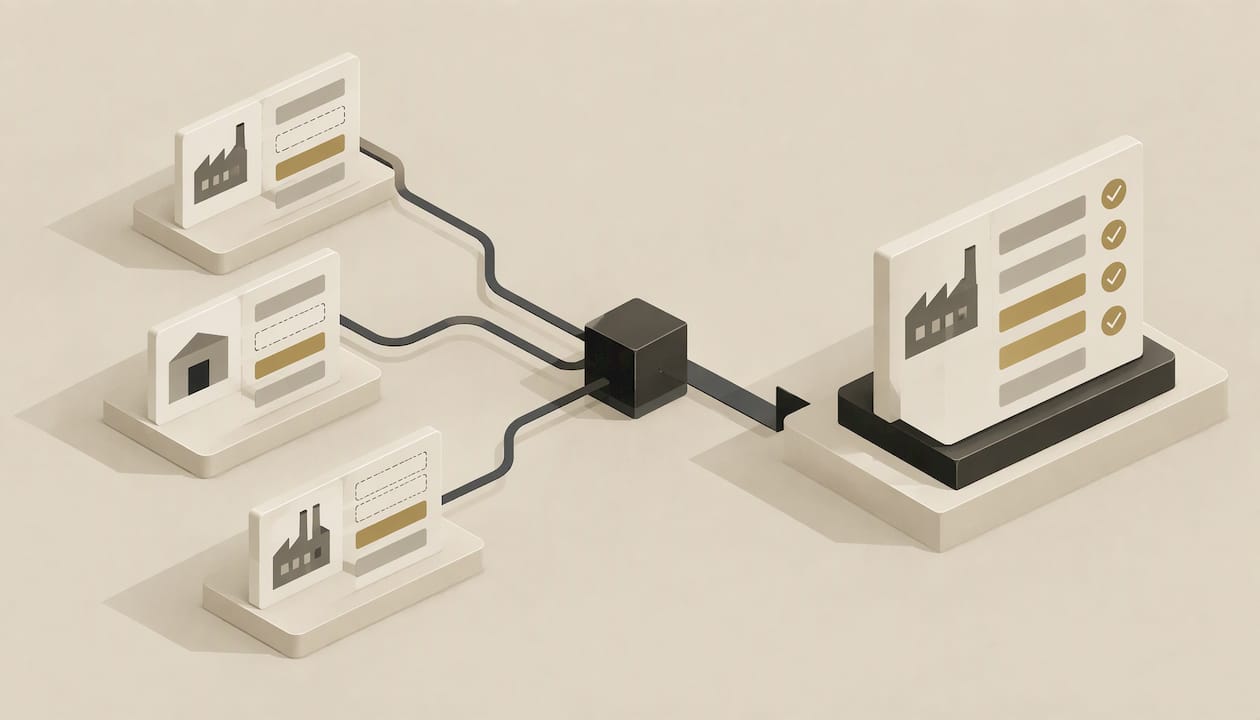
Procurement data enrichment means adding external facts to the supplier, vendor and spend records you already hold: who owns the company, how financially stable it is, what it makes, where it operates and what risk it carries. The result that matters is a record you can act on without opening ten browser tabs. Milda gives teams that layer from one place: a database of more than 420 million companies and 50 million verified contacts, with ownership, financials, risk assessments, trade data and patents, reachable through search, a browser extension or an API.
This guide covers what enrichment adds, how to match records correctly, how it differs from supplier discovery, and how to tell whether it is paying off.
TL;DR
- Enrichment appends external attributes (legal entity, parent company, financial and risk indicators, certifications) to records you already have, and keeps the original values traceable.
- Matching on a persistent identifier such as a registration number, not on the company name, is what separates a usable result from a polluted database.
- Supplier discovery finds companies you do not yet have. Enrichment deepens the ones you do. Strong teams use the same data layer for both.
- Judge value by decisions improved: fewer duplicate suppliers, earlier risk flags, faster onboarding, better-prioritized sourcing.
- Coverage decides everything. A data source that misses your long-tail suppliers leaves the hardest records bare.
Table of Contents
- What procurement data enrichment actually is
- What you can add, and where it comes from
- How to match, verify and maintain enriched records
- Why clean data pays: the evidence
- Enrichment versus supplier discovery
- Using enriched data for decisions
- How to evaluate a data source and measure results
- What Milda offers procurement and sourcing teams
- Our view: coverage comes before everything
- FAQ
- Sources
What procurement data enrichment actually is
A typical supplier record in an ERP is thin: a name, an address, a payment term and a spend total. One procurement guide gives a useful example. A record for a Swedish supplier with EUR 750,000 in annual spend becomes far more useful once it carries the registered legal name, registration number, corporate parent and ultimate parent, industry classification, company size, a financial-risk indicator, certifications and a last-validation date. Suddenly you can ask whether this supplier belongs to a larger group, or whether it is financially stable enough for a multi-year contract.
Three neighbors are often confused with enrichment:
- Cleansing fixes errors in what you have: typos, formats, duplicates.
- Classification assigns spend to a taxonomy such as UNSPSC or an internal category tree.
- Master data management governs which record is the authoritative one.
Enrichment is different because it brings in information you did not have. In practice you need all four, and enrichment tends to work best after cleansing, because a bad record enriched is still a bad record.
What you can add, and where it comes from
The attributes procurement teams reach for most fall into a handful of groups.
| Attribute group | Examples | Typical question it answers |
|---|---|---|
| Legal entity | Registered name, registration number, status | Is this who we think we are paying? |
| Ownership | Parent, ultimate parent, shareholders | Are three “different” vendors one group? |
| Financial | Revenue, size, financial-risk indicators | Can this supplier carry the contract? |
| Capabilities | Products, technologies, patents, trade activity | Who else can make this? |
| Location | Sites, geographic exposure | Where is our supply concentrated? |
| Compliance and risk | Certifications, risk and sustainability data | Which suppliers need review first? |
The same guide lists the usual origins: your internal systems, supplier-provided information, government and regulatory registers, commercial business-information providers, market research, price and cost indexes, and risk and sustainability sources.
Here is the practical problem. Each of those sources covers part of the picture, and stitching them together by hand is slow. A single platform that already combines multi-source company data removes the stitching. Milda’s database spans firmographics, ownership and shareholders, financials, risk assessments, trade data, patents and publications, so one lookup can return the legal, financial and capability facts a buyer needs. You can see what is covered on the data coverage page.
How to match, verify and maintain enriched records
Enrichment fails quietly when records are matched wrongly. A vendor named “Delta Systems” exists in dozens of countries. The routine below prevents most damage.
1. Match on identifiers, not names
Use a company registration number, tax identifier, legal-entity identifier, D-U-N-S Number or another persistent business identifier, plus address or bank details where you have them. The guidance is explicit that name alone is not enough. Where you do not have an identifier, a platform that resolves company names to a verified entity gives you a starting point. Milda’s browser extension brings company data into the page you are already on, which helps when you are checking a vendor from a website, a bid document or a LinkedIn page. Details are on the browser extension page.
2. Set confidence thresholds
Accept high-confidence matches automatically, route medium-confidence ones to a person, and reject the rest. Research on tender data shows why this matters even for good systems: a peer-reviewed study of European public procurement data built a classifier for procurement categories that reached 83% precision and 88% recall, so a meaningful share of records still needed review.
3. Keep the original value
Add the new attribute beside the old one. Do not overwrite. Keep the source, the date and the status of the match, so an auditor or a colleague can see where a field came from. A corrected analytical label is also not permission to change a payment record in the ERP; keep those two layers apart.
4. Assign ownership and refresh cadence
Every enriched field needs an owner, an approved source, a validation method and an update frequency. A financial-risk flag may need monthly refreshes, while a registered address may change rarely. A field with no owner goes stale first.
5. Test a sample before a full load
Pull a few hundred records, compare them against an authoritative register, and count the errors. Then load the rest. For the integration itself, this guide to IT procurement services covers the technology stack questions that come up when connecting a new data source to existing systems. Milda delivers the same data through an API, so enrichment can run inside the tools your team already uses.
Why clean data pays: the evidence
Two academic studies make the case without a vendor’s spin.
Researchers working with the UK food producer Cranswick enriched 1,921 supplier records with web-scraped business descriptions and product details, then classified suppliers into industry categories. Their simulation projected annual savings of £16 to £22 million. That is a simulation, not a guarantee, but it shows the mechanism: once you know what suppliers actually do, you can see consolidation and competition opportunities that a bare name hides.
A second study on integrated master data management reports data consistency rising from 72% to 98%, duplicate supplier records falling from roughly 450 to fewer than 50, and master data approval time dropping from 5 to 7 days to 1 to 2 days.
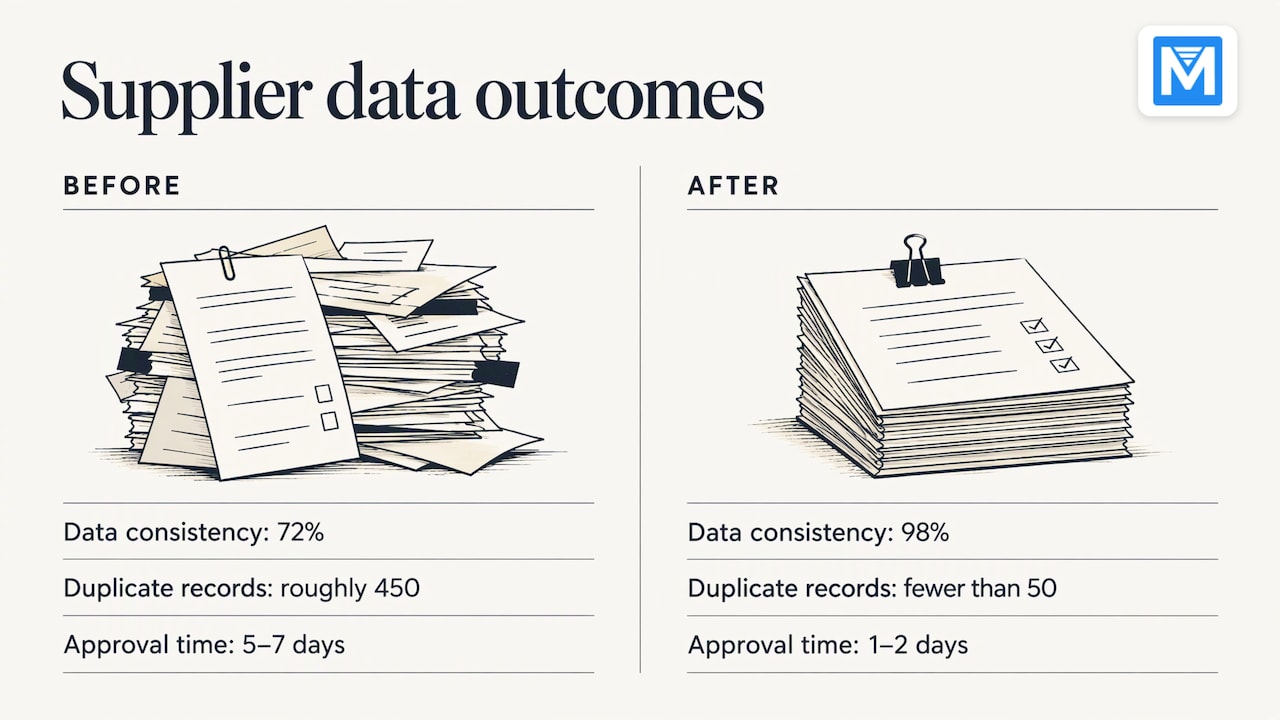
The pattern is the same in both: better attributes lead to fewer duplicates, faster approvals and sharper sourcing decisions.
Enrichment versus supplier discovery
Supplier discovery platforms help you find companies that are not yet in your system: by capability, location, size, technology or trade activity. Enrichment works on the other side: it takes a supplier you already have, or one you have just found, and fills in the facts you need to judge it.
In practice the two collapse into one workflow:
- Discover candidates by what they make, where they operate and how large they are.
- Enrich each shortlisted candidate with ownership, financials and risk.
- Compare them in a structured way and invite the best to bid.
- Write back the winner’s verified record into your supplier master.
The quality of step one depends on coverage. Milda’s positioning is that its proprietary and multi-source data surfaces up to three times more companies than others, which matters most for niche categories where the right supplier is a small or foreign firm that narrower databases never list. For a deeper look at the search side, see our guide to company sourcing strategies, and for the risk step, our supplier due diligence guide for US teams.
The same logic applies to vendor risk in other functions. This piece on vendor due diligence risk tiers shows how tiering vendors by exposure focuses scarce review time, which is exactly what enriched data lets you do at scale in procurement.
Using enriched data for decisions
Once records carry the right attributes, several analyses become routine:
- Risk prioritization. Rank suppliers by financial-risk indicator and spend, and review the worst combinations first. Our supplier risk monitoring guide shows how to set that up in 90 days using NIST guidance.
- Concentration. Group suppliers by ultimate parent to find where “five vendors” are really one corporate group.
- Coverage gaps. Find categories with spend but no contract.
- Certification tracking. Flag certificates close to expiry before an audit does.
- Price context. Compare a price increase against market indicators.
- Contacts. Reach the right person at a new supplier. Our note on contact enrichment explains how to do it properly, and the same governance principles apply as in our piece on CRM data enrichment.
One caution from practitioners is worth keeping: enrichment is valuable when it improves a specific decision, not when it adds fields to a dashboard. A probable category is fine for an initial opportunity screen. Replacing a supplier needs validated specifications and qualification evidence.
How to evaluate a data source and measure results
Before you commit, score any enrichment source on relevance, coverage (countries, sectors, supplier sizes, legal entities), authority, accuracy, timeliness, matching capability, integration, licensing and usage rights, data protection and commercial value. Those criteria come from procurement guidance, and our data vendor evaluation scorecard turns them into a working checklist.
After go-live, track outcomes that map to decisions:
- Reduction in duplicate supplier records
- Share of spend that is classified
- Time to onboard a supplier
- How early risks are identified
- Fewer expired certificates
- Hours of manual data preparation saved
Pick three, record a baseline before you start, and report the change each quarter.
What Milda offers procurement and sourcing teams
Milda is built for teams that need company data in several places at once. Browser Analyst puts company intelligence into your browsing workflow, Strategy Terminal supports deeper research and market mapping, and Data Solutions delivers the data through an API into your own systems. Records cover firmographics, ownership, financials, risk assessments, trade data, patents and growth signals, and our data is source-verified and GDPR-compliant. Pricing adapts to team size and data usage; see the pricing page to choose the product that fits your team.

For market mapping and supplier landscape work, the market research use case shows how the platform is applied.
Our view: coverage comes before everything
Most enrichment projects are framed as a data-cleaning job. We think they are a coverage question first. If the source does not know your supplier, no matching rule rescues the record, and it is usually the small, foreign or newly formed suppliers that carry the most risk and the most opportunity.
That is why we built Milda on a database of more than 420 million companies and 50 million verified contacts, combining proprietary and multi-source data so that ownership, financials, risk and growth signals sit on one record. Procurement, business development, investment and strategy teams all ask versions of the same question: who is this company, who owns it, and what is it doing next? One verified answer, reachable by search, browser extension or API, beats three partial ones.
Our advice is to start with the decision, not the field list. Choose the three decisions your team makes most often, enrich only what they need, and measure whether they get faster and better.
Vilius Stanciauskas, Founder and CEO
FAQ
What is an example of procurement data enrichment?
Take a supplier record that holds only a name, an address and annual spend. Enrichment adds the registered legal name, registration number, parent company, industry code, size, a financial-risk indicator and certifications. You can then see, for example, that two vendors share one parent.
What is the difference between supplier data enrichment and vendor data enrichment?
In most organizations the terms mean the same thing: appending external attributes to the records of companies you buy from. “Vendor” is more common in IT and finance, “supplier” in manufacturing and sourcing. The method, matching and validation steps are identical.
How does enrichment differ from data cleansing?
Cleansing corrects errors in the data you already hold, such as duplicates and inconsistent formats. Enrichment adds information you did not have. Cleansing usually comes first, so that enrichment attaches new facts to the right record.
How often should enriched supplier data be refreshed?
It depends on the attribute. Fast-moving fields such as risk indicators and certification status need frequent refreshes, while legal names and registration numbers change rarely. Give each field an owner, a source and an update frequency, and record when it was last checked.
Sources
- Procurement Data Enrichment: What It Is and Why It Matters
- Data Quality Barriers for Transparency in Public Procurement
- Automating Procurement Practices using enrichment and classification (UCL)
- Enhancing Procurement Efficiency through Integrated Master Data Management